
Next generation and WiFi enabled loggers
Next Generation loggers are characterized as having more than just an SD card to eject and manually upload data. These loggers currently include the Wireless Inexpensive Bathymetry Logger (WIBL), the Nemo30 logger (with WIBL software), and the Orange Force Marine Mussel Kits. These loggers allow a vessel to continuously transmit data to either the parent organization, or via Orange Force Marine as a third party. Then, data can be transformed and submitted to the DCDB. Real-time data transformation and submission is a new tool under development that is currently available through Orange Force Marine. This is also something that can be accomplished independently using open-access tools that are available through the WIBL and Open VBI GitHub repositories.
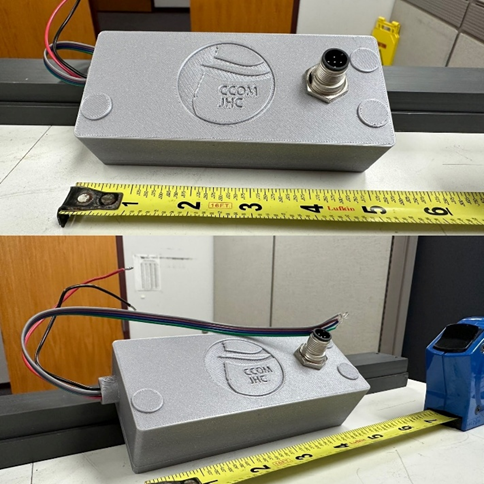
Wireless Inexpensive Bathymetry Logger (WIBL)
The WIBL logger was developed by Brian Calder and Brain Miles’ team at the Center for Coastal and Ocean Mapping at the University of New Hampshire. As of the release of this manual, WIBL has released hardware version 2.5.1 and firmware version 1.6.1. This version of the logger supports NMEA-0183 (two channels) and NMEA-2000 as inputs, and can generate data on NMEA-0183 (two channels) if required for debugging.
The loggers are configured in a typical setup. The JSON configuration files corresponding to the loggers can be queried for their current configuration with the DesktopUI tool in the repository. The loggers are all configured to bring up their configuration web server on boot (the SSID will be for example wibl-comitXX-config for logger XX, with password wibl-config-password), so you can attach to them directly without having to crack open the box. Instructions on how to do this are in the Wiki associated with the repository, https://bitbucket.org/ccomjhc/wibl/wiki/Home.
Orange Force Marine (OFM) Mussel Kit
Developed in 2021 by Derek Niles and Colin Thomson, Orange Force Marine Ltd., offers two types of “Next Generation” data loggers as part of their CSB solution. The first type is a standard, Wi-Fi enabled data logger and the second type is a Cellular (3G/4G/5G) enabled data logger that also has a separate GPS antenna, cellular antenna, and internal inertial motion unit (IMU).
These data loggers have an internal 8 GB SD storage card and automatically connect and upload data to the cloud when in Wi-Fi or cellular range. Outside of connectivity, the Mussel Kit will store data on the SD card until it once again resumes connectivity and can upload the backlog of collected data. The loggers send up a “heartbeat” message periodically and can be remotely configured (or reconfigured), remotely updated (firmware), and monitored by OFM for operational status. The data logger units are NMEA 2000 enabled, although they can be employed on NMEA 0183 networks by way of a NMEA 2000 to NMEA 0183 adaptor (such as the Actisense NGW-1 or NGX-1 units).
After initial installation and configuration onboard a vessel, the Mussel Kit automatically collects and uploads data without requirements for vessel operator intervention or action. When a Mussel Kit is connected to cellular or Wi-Fi, collected CSB data are automatically uploaded to OFM’s AWS S3 Cloud, processed, and sent onwards to the IHO DCDB in near-real time.